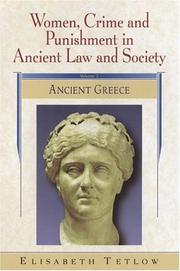
An edition of Women, Crime And Punishment In Ancient Law And Society (2004)
Women, Crime And Punishment In Ancient Law And Society
Ancient Greece
By Elisabeth Meier Tetlow
Publish Date
June 30, 2005
Publisher
Continuum International Publishing Group
Language
eng
Pages
338
Description:
"This volume, spanning three millennia BCE, concentrates on the major ancient civilizations that left information about women and crime in Mesopotamia and Asia Minor, namely, Sumer (Pt I), Babylonia (Pt II), Assyria (Pt III), and Khatti (Pt IV). Most of the extant writings are incomplete, and some are only brief fragments. No ancient document has been found that contains the entire civil or criminal code of a civilization or all of its laws affecting women. Each document contains a small piece of the puzzle. When put together here with other writings, art, and artifacts, a general picture of the treatment of women, crime and punishment in each of these ancient civilizations begins to emerge. The book includes illustrations, an extensive Chronology and Names, and Indices of Persons, Places, and Subjects. Crime and punishment, criminal law and its administration, are areas of ancient history that have been explored less than many other aspects of ancient civilizations. Throughout history women have been affected by crime both as victims and as offenders. In the ancient world, customary laws were created by men, formal laws were written by men, and both were interpreted and enforced by men. This two-volume work explores the role of gender in the formation and administration of ancient law and examines the many gender categories and relationships established in ancient law, including legal personhood, access to courts, citizenship, political office, religious office, professions, marriage, inheritance, and property ownership. Thus it focuses on women and crime within the context of women in the society."--Bloomsbury Publishing This volume, spanning three millennia BCE, concentrates on the major ancient civilizations that left information about women and crime in Mesopotamia and Asia Minor, namely, Sumer (Pt I), Babylonia (Pt II), Assyria (Pt III), and Khatti (Pt IV). Most of the extant writings are incomplete, and some are only brief fragments. No ancient document has been found that contains the entire civil or criminal code of a civilization or all of its laws affecting women. Each document contains a small piece of the puzzle. When put together here with other writings, art, and artifacts, a general picture of the treatment of women, crime and punishment in each of these ancient civilizations begins to emerge. The book includes illustrations, an extensive Chronology and Names, and Indices of Persons, Places, and Subjects. Crime and punishment, criminal law and its administration, are areas of ancient history that have been explored less than many other aspects of ancient civilizations. Throughout history women have been affected by crime both as victims and as offenders. In the ancient world, customary laws were created by men, formal laws were written by men, and both were interpreted and enforced by men. This two-volume work explores the role of gender in the formation and administration of ancient law and examines the many gender categories and relationships established in ancient law, including legal personhood, access to courts, citizenship, political office, religious office, professions, marriage, inheritance, and property ownership. Thus it focuses on women and crime within the context of women in the society.