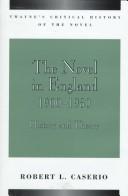
An edition of The novel in England, 1900-1950 (1999)
The novel in England, 1900-1950
history and theory
By Robert L. Caserio
Publish Date
1999
Publisher
Twayne Publishers,Prentice Hall International
Language
eng
Pages
441
Description:
In the first half of the twentieth century, English fiction played a crucial role in the artistic and intellectual movement called modernism. In recent decades, however, modernism and its proponents have come under attack. Today's critics claim that modernist fiction has been socially and politically harmful, and that literary modernism has fortunately been superseded by "post-modernism.". Robert L. Caserio argues that such a critical assessment does not justly comprehend the English novel's history or significance between 1900 and 1950. It's significance, Caserio hypothesizes, is the novel's picture of the impact of chance on human endeavor. The rule of chance frees fictions from the need to "mirror" reality, but this independence does not make the novel unresponsive to the worldly claims of history and politics. On the basis of new readings of dozens of novels and novelists, Caserio contends that modernist fiction contributed to the liberation of women, the creation of the British welfare state, and the demise of the British Empire.