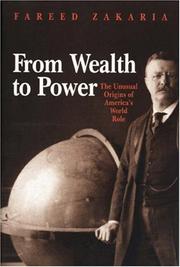
An edition of From wealth to power (1998)
From wealth to power
the unusual origins of America's world role
By Fareed Zakaria
Publish Date
1998
Publisher
Princeton University Press
Language
eng
Pages
210
Description:
If rich nations routinely become great powers, Zakaria asks, then how do we explain the strange inactivity of the United States in the late nineteenth century? By 1885, the U.S. was the richest country in the world. And yet, by all military, political, and diplomatic measures, it was a minor power. To explain this discrepancy, Zakaria considers a wide variety of cases between 1865 and 1908 in which the U.S. considered expanding its influence in such diverse places as Canada, the Dominican Republic, and Iceland. Taking a position consistent with the realist theory of international relations, he argues that the President and his administration tried to increase the country's political influence abroad when they saw an increase in the nation's relative economic power. But they frequently had to curtail their plans for expansion, he shows, because they lacked a strong central government that could harness that economic power for the purposes of foreign policy. America was an unusual power - a strong nation with a weak state. It was not until late in the century, when power shifted from states to the federal government and from the legislative to the executive branch, that leaders in Washington could mobilize the nation's resources for international influence.
subjects: International relations, Foreign relations, World politics, World history, United states, foreign relations, 1865-1898, United states, foreign relations, 1901-1913, United states, foreign relations, 1913-1921, New York Times reviewed, POLITICAL SCIENCE, Government, International, General, HISTORY / United States / 19th Century, Diplomatic relations, Relations internationales, Relations extérieures, Weltpolitik, Buitenlandse betrekkingen, Rijkdom, Politieke macht, Grandes puissances
Places: United States
Times: 1865-1921