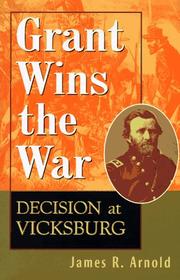
An edition of Grant Wins the War (1997)
Grant wins the war
decision at Vicksburg
By James R. Arnold
Publish Date
1997
Publisher
J. Wiley & Sons,John Wiley
Language
eng
Pages
387
Description:
Historian James R. Arnold powerfully and persuasively argues that the Union victory at Vicksburg in 1863 was in fact the actual turning point of the war. Grant was unlike Lincoln's other generals. He had won a great victory at Fort Donelson, but that was more than a year earlier. His subsequent command at the battle of Shiloh became a bloodbath, and most people attributed the eventual Union victory not to Grant, but to the leadership of the reinforcing army's commander, Major General Don Carlos Buell. As he began his drive into Mississippi, Grant was on trial, both as a man and as a leader. After repeated failures, Grant outflanked Vicksburg and won a dramatic victory at the battle of Port Gibson, securing a bridgehead over the Mississippi River below Vicksburg. He now occupied a position situated between the two fortified Confederate citadels of Vicksburg and Port Hudson, with his back to the continent's greatest river and his army dependent upon a precarious line of supply. The conventional military solution, and the one favored by President Lincoln and his top military adviser, was to cooperate with General Banks against Port Hudson. But Grant's experience had taught him that the risks of converging two columns almost one hundred miles apart against a common target were considerable. Instead, in the riskiest and greatest decision of his military career, Grant resolved to act alone against Vicksburg. James R. Arnold proposes that Grant's victory at Vicksburg is worthy of comparison to those of Napoleon in its planning and execution. Always prepared for multiple contingencies, the general kept his field army well concentrated within a few hours' march of each other, while keeping Confederate General Pemberton - trying to counter Grant's shrewd troop movements - continually off balance. The decisive meeting came on May 16, at Champion Hill. Bringing history to exciting life, James R. Arnold offers a penetrating analysis of Grant's strategies and actions. His carefully researched chronicle approaches these epic events from a unique and well-rounded perspective: What did Grant know ... and think? What did his opponents know ... and think? What was the true state of affairs? Grant Wins the War is fascinating reading for all Civil War and military history buffs.