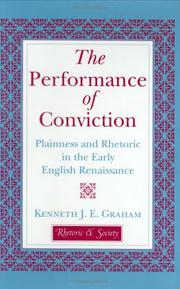
An edition of The performance of conviction (1994)
The performance of conviction
plainness and rhetoric in the early English Renaissance
By Kenneth J. E. Graham
Publish Date
1994
Publisher
Cornell University Press
Language
eng
Pages
232
Description:
Belief or skepticism, obedience or resistance to authority, theatricality or stoic self-possession - Kenneth J. E. Graham explores these alternatives in the culture of early modern England. Focusing on plainness - a stylistic feature of much Renaissance writing - he surveys texts including Wyatt's anti-courtly verse, the Puritan Admonition to Parliament, Ascham's Scholemaster, Greville's non-dramatic writings, and works of Shakespearean tragedy, revenge tragedy, and verse satire. Graham shows how plainness functions not only as a literary style, but also as a mode of political and religious rhetoric that reflects powerful historical currents. Plainness is a result of the claim to possess the plain truth - a self-evident, absolute truth. In the absence of rhetorical criteria for truth, however, plainness registers a conviction that is plain to those who share it but opaque to those who don't. The plain truth can denote either the truth proclaimed and enforced by a public authority, whether liberal or conservative, or the truth of private conviction, which may oppose public authority. According to Graham, the pervasiveness of plainness in the sixteenth and early seventeenth centuries is evidence of a failure of consensus, as authorities made conflicting, irresolvable claims to certainty. The rhetoric of plainness, he asserts, reveals a profound opposition between the attitude of persuasion, a moderately skeptical, pragmatic, and inclusive outlook characteristic of Erasmian humanism, and a stance of conviction, an absolutist, essentialist, and exclusive attitude more typical of Neostoicism and political and moral conservatism.
subjects: Rhetoric, History and criticism, Renaissance Rhetoric, Literature and society, English literature, Social aspects of Rhetoric, Renaissance, History, English literature, history and criticism, early modern, 1500-1700, Renaissance, england, Social aspects, Early works to 1800
Places: England
Times: 16th century, Early modern, 1500-1700