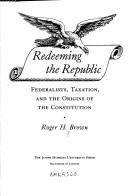
An edition of Redeeming the Republic (1993)
Redeeming the Republic
Federalists, taxation, and the origins of the Constitution
By Roger H. Brown
Publish Date
1993
Publisher
Johns Hopkins University Press
Language
eng
Pages
345
Description:
Why were Federalists at the 1787 Philadelphia convention - ostensibly called to revise the Articles of Confederation - so intent on scrapping the old system and drawing up a completely new frame of government? Historians traditionally have pointed to national and international failures of the Articles, including American diplomatic impotence, disrupted foreign and interstate trade, varied currency, and an inveterate provincialism that most readily appeared in the refusal of state governments to finance Congress. In Redeeming the Republic, Roger Brown focuses instead on state public-policy issues to show how recurrent outbreaks of popular resistance to tax crackdowns forced state governments to retreat from taxation, propelling elites into support for the constitutional revolution of 1787. The Constitution, Brown contends, resulted from upper-class dismay over the state governments' inability to tax effectively for state and federal purposes. The Framers concluded that, without a rebuilt, energized central government, the confederation would experience continued monetary and fiscal turmoil until republicanism itself became endangered. A fresh and searching study of the hard questions that divided Americans in these critical years - and still do today - Redeeming the Republic shows how local failures led to federalist resolve and ultimately to a totally new scheme of federal government. Brown's study also provides a sympathetic view of the Antifederalists, who emerge not as agrarian localists but as champions of tax relief and opponents of a Constitution they expected would make government less responsive to popular distress.
subjects: Constitutional history, Politics and government, United States. Constitutional Convention (1787), Taxation, United States, States, History, Taxation, united states, United states, constitutional convention (1787), Constitutional history, united states, United states, politics and government, 1783-1809, Taxation, history
Places: United States
Times: 1783-1789, 18th century