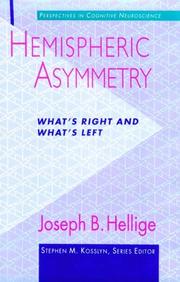
An edition of Hemispheric asymmetry (1993)
Hemispheric asymmetry
what's right and what's left
By Joseph B. Hellige
Publish Date
1993
Publisher
Harvard University Press
Language
eng
Pages
404
Description:
A magazine advertisement for a luxury automobile calls it a "car for the left side of your brain" because of its state-of-the-art engineering and a "car for the right side of your brain" because of its sleek styling. In the past few years, such popular renderings of "right brain" and "left brain" functioning have encouraged the belief that the left hemisphere controls symbolic processing and rational thinking while the right hemisphere controls artistic, intuitive, and creative thinking. Joseph B. Hellige argues that this view is far too simplistic. In this book, Hellige attempts to sort what we know about hemispheric asymmetry from the fanciful interpretations popular culture has embraced. The cortex of the human brain, which has more neurons than any other brain structure, is responsible for the higher-order mental processes that make human beings unique among species. Anatomically, the cortex is divided into right and left hemispheres roughly equivalent in appearance but not completely equivalent in information-processing abilities and propensities. Indeed, the two hemispheres are components of a much larger brain system encompassing numerous subcortical structures, all of which interact in the normal brain to produce unity of thought and action. How, then, do the two hemispheres interact to form an integrated information-processing system? What is the relationship of hemispheric asymmetry to perception, cognition, and action? Is hemispheric asymmetry unique to humans, and how did it evolve? In this book, the author surveys the extensive data in the field and provides a valuable overview of our current understanding of hemispheric asymmetry and its evolutionary precedents.