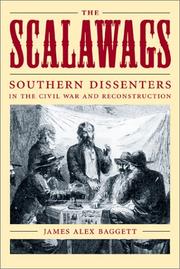
An edition of The Scalawags (2002)
The Scalawags
southern dissenters in the Civil War and Reconstruction
By James Alex Baggett
Publish Date
2003
Publisher
Louisiana State University Press
Language
eng
Pages
323
Description:
"In Thomas Dixon's novel that became the film The Birth of a Nation, the scalawag - a white southerner who supported Congressional Reconstruction and the Republican Party - is summarized as a "Judas Iscariot who sold his people for thirty pieces of silver, which he got for licking the feet of his conqueror and fawning on his Negro allies." Departures from this stereotypical view have appeared slowly since the 1940s as important revisionist historians dispelled the negative connotations surrounding scalawags - but only on a state-by-state basis." "James Alex Baggett's The Scalawags uncovers the genesis of scalawag leaders in the entire former Confederacy. Taking the period of the 1850s to 1870s, Baggett uses a collective biography approach to compile profiles of 742 scalawag-Republicans, whom he then compares and contrasts with their counterparts - 666 redeemer-Democrats who opposed and replaced them. Significantly, he analyzes this rich data by region - the Upper South, the Southeast, and the Southwest - as well as for the South as a whole." "Baggett follows the life of each scalawag before, during, and after the war, revealing real personalities and not mere statistics. Examining such features as birthplace, vocation, estate, slaveholding status, education, political antecedents and experience, stand on secession, Republican Party involvement, war record, and postwar political activities, he finds striking uniformity among scalawags despite their regional differences and varying circumstances." "This first Southwide study of the scalawags rescues from the shadows once-vilified men who are vital to understanding Reconstruction and illustrates the events surrounding their political decisions. Its scope and astounding wealth in quantity and quality of sources - census data, manuscripts, and newspapers, to name a few - make it the definitive work on the subject."--Jacket.
subjects: Politics and government, Dissenters, Whites, Politicians, Public opinion, United States Civil War, 1861-1865, Reconstruction (U.S. history, 1865-1877), History, Unionists (United States Civil War), United states, history, civil war, 1861-1865, public opinion, Politicians, united states, Southern states, politics and government, Confederate states of america, politics and government, White people, Reconstruction
Places: Confederate States of America, Southern States, United States
Times: 1775-1865, 1865-1950, 19th century, Civil War, 1861-1865