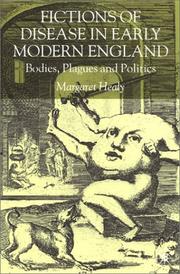
An edition of Fictions of disease in early modern England (2001)
Fictions of disease in early modern England
bodies, plagues and politics
By Margaret Healy
Publish Date
2001
Publisher
Palgrave
Language
eng
Pages
284
Description:
"How did early modern people imagine their bodies? What impact did the new disease syphilis and recurrent outbreaks of bubonic plague have on these mental landscapes? Why was the glutted belly such a potent symbol of pathology? Fictions of Disease is a unique exploration of the stories laymen and physicians constructed around such bodies, producing a fascinating cultural imaginary of bodily disorder. Healy argues that these narratives not only shaped visions of unhealthy social bodies, but had profound political consequences too. City spaces, social and religious structures, economic initiatives, and drastic decisions about how to cure the disease at the head of the English body, were fashioned by circulating fictions of 'plaguy', 'pocky' and 'glutted' bodies. Ranging from the Reformation through the English Civil War, this original approach opens an important new window of understanding onto the period's disease-impregnated literature, including works by Shakespeare, Milton, Heywood, Dekker and others."--Jacket. "How did early modern people imagine their bodies? What impact did the new disease syphilis and recurrent outbreaks of bubonic plague have on these mental landscapes? Why was the glutted belly such a potent symbol of pathology? Fictions of Disease is a unique exploration of the stories laymen and physicians constructed around such bodies, producing a fascinating cultural imaginary of bodily disorder. Healy argues that these narratives not only shaped visions of unhealthy social bodies, but had profound political consequences too. City spaces, social and religious structures, economic initiatives, and drastic decisions about how to cure the disease at the head of the English body, were fashioned by circulating fictions of 'plaguy', 'pocky' and 'glutted' bodies. Ranging from the Reformation through the English Civil War, this original approach opens an important new window of understanding onto the period's disease-impregnated literature, including works by Shakespeare, Milton, Heywood, Dekker and others."--BOOK JACKET.
subjects: Body, Human, in literature, Diseases in literature, English literature, History, History and criticism, Intellectual life, Literature and medicine, Medicine in literature, Plague in literature, Politics and literature, Human body in literature, English literature, history and criticism, early modern, 1500-1700, Great britain, intellectual life, Modern Literature, Human Body, History, 17th Century, History, 16th Century, History of Medicine
Places: England, Great Britain