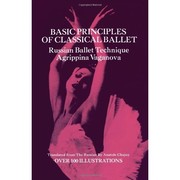
An edition of Basic Principles of Classical Ballet (1948)
Basic principles of classical ballet
Russian ballet technique
By Agrippina Yakovlevna Vaganova
Publish Date
1948
Publisher
Adam & CharlesBlack
Language
eng
Pages
139
Description:
The correct translation of the title of this book should read, "Foundation of Classical Dance" rather than "Russian Ballet Technique." As the Forward from the original Russian explains (and which is oddly missing from the English editions-- supposedly because it is "too political"), the method Vaganova founded was not intended to be the RUSSIAN method, but rather, the UNIVERSAL method for teaching classical dance. In founding classical ballet teaching method, Vaganova took the most difficult steps that were seen on the stage and broke them down "frame by frame"--into their most basic elements--in order to systematically develop the student into a classical artist. She consulted with the leading scientists in various fields at her time, and she tested the effectiveness of her methods as if the dance school was her "laboratory." The resulting method (broadened and perfected by Vera Kostrovitskaya, Vaganova's pupil) is completely physiologically sound and is the only scientifically based method for teaching classical ballet to date. The continuation of this work is found in Vera Kostrovitskaya's "School of Classical Dance", which explains the progression of the exercises in greater detail, while this book by Vaganova mainly focuses on the final form. For those wishing to become teachers of classical dance, it is also necessary to learn all of the rules and details for executing each of the forms: these details can be found in a new book series by Peggy Willis-Aarnio (pupil of John Barker, Vera Kostrovitskaya's principle pedagogical student) called, "How To Teach Classical Ballet" (first edition published by Taiteilia Publishing, Panama City Beach, FL.)