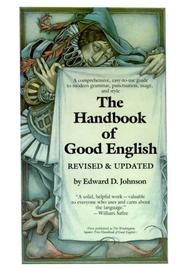
An edition of The Washington Square Press handbook of good English (1982)
The handbook of good English
By Edward Dinwoody Johnson
Publish Date
1991
Publisher
Facts on File
Language
eng
Pages
309
Description:
This book is strict rather than permissive, because it assumes that those who consult it want to be protected from criticism. Its four chapters are a series of rules, each rule followed by examples, explanations, and exceptions. The rules are for the most part the familiar ones taught in primary and secondary schools, but I have tried to extend them far enough to be useful to sophisticated adult users of the language, those whose thought is complex and whose verbal dilemmas are correspondingly complex. The Glossary / Index at the back of the book both serves as an index to the rules and provides information and advice on specific matters of English usage; it also defines the grammatical terms used throughout the book. When the Glossary/ Index does not answer a question directly but refers the reader to a rule, I advise reading the entire rule, even though some of them are rather long; an understanding of the general principles underlying each rule is important. Good English changes over the course of time, and at any given time there is some disagreement about what it is. All of us have occasional problems with it, and those whose problems are frequent are understandably impatient with its rules and strictures and even contemptuous of them. Good English is, after all, a kind of institutionalized snobbery—those whose English is good look down on those whose English isn't good; those whose English isn't good are either in constant fear of giving themselves away or find some more or less self-respecting way of defying those whose English is good. Grammar and usage are therefore touchy subjects. We expect occasional correction from a parent or a teacher, but any friend who corrects us had better be a good friend indeed. My advice is to take good English seriously—it is, after all, a standard of communication, and standards are necessary—but not to worship it. We take the rules and bounds of a game such as baseball or tennis seriously, because otherwise the game can't be played, but we don't worship such rules and bounds. Communication is much like a game, and those who know its rules—those who have a command of good English—play it better than those who don't; they can both please themselves and please others with their play. I hope those who use this book will find that it helps them take pleasure in their language.