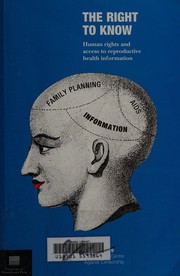
An edition of Right to know (1995)
Right to know
human rights and access to reproductive health information
By Article 19.
Publish Date
1995
Publisher
Article 19
Language
eng
Pages
450
Description:
This book documents the massive deprivation of human rights resulting from governmental censorship, manipulation, and control of reproductive health and sexuality information. The introductory chapter applies a human rights perspective to reproductive health to show that women must have full and impartial information to be able to choose services which further their goals rather than governmental policies. Examples of different types of state manipulation are provided, and demographic, biomedical, and reproductive health paradigms of contraceptive delivery programs are described. Chapter 2 identifies the binding obligations imposed on governments by the international principle that women have a right to appropriate reproductive health information. The third chapter provides a global overview of such topics as health expenditures, fertility rates, infertility, literacy and education, infant and child mortality, maternal mortality, child spacing, contraceptive usage, unmet need, abortion, HIV/AIDS, and sexually transmitted diseases (STDs). Chapters 4-13 present country reports for Algeria, Brazil, Chile, Ireland, Kenya, Malawi, Pakistan, the Philippines, Poland, and the US. The country reports reveal the overwhelming need of women to have access to this information and the innumerable ways in which governments control such access. The country reports also describe factors such as religion, culture, tradition, state of development, and influence of foreign donors which have an impact on access to information. Each country report ends with specific recommendations, and the concluding chapter defines seven obligations of national governments imposed by the right to information contained in international law and contains recommendations of ways nongovernmental organizations can use these obligations to lobby governments for improvements.
subjects: Freedom of information, Law and legislation, Women's health services, Health services accessibility, Abortion, Human reproduction, Women's rights, Health education, Birth control, Induced Abortion, Contraception, Family Planning Services, Human Rights, Information Dissemination, Information Services, International Cooperation, Internationality, Women's Health, Communication, Health Planning, Health Planning Guidelines, Reproductive Medicine, Régulation des naissances, Droit, Reproduction humaine, Avortement, Éducation sanitaire, Femmes, Droits, Santé, Services de, Accessibilité, Recht op informatie, Gezondheid, Risico's, Voortplanting (biologie), Geboorteregeling, AIDS, Mensenrechten, Droits de l'homme, Études transculturelles, Liberté d'information, Santé et hygiène, Education sanitaire, Cross-cultural studies, Women, Health and hygiene, Government policy, Sex and law, Freedom of information (International law), Cross-Cultural Comparison, Health, Hygiene, Sex, Education, Family Planning Policy, Sexually Transmitted Diseases, Epidemiology