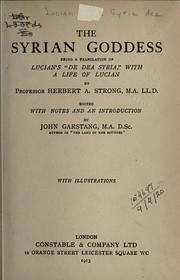
An edition of The Syrian Goddess (1913)
The Syrian goddess
being a translation of Lucian's De dea Syria, with a life of Lucian by Herbert A. Strong. Edited with notes and an introd. by John Garstang.
By Lucian of Samosata
Publish Date
1913
Publisher
Constable
Language
eng
Pages
86
Description:
De Dea Syria (Greek: Περὶ τῆς Συρίης Θεοῦ, "Concerning the Syrian Goddess") is the conventional Latin title of a Greek treatise of the 2nd century AD, which describes religious cults practiced at the temple of Hierapolis Bambyce, now Manbij, in Syria. The work is written in a Herodotean-style of Ionic Greek, and has been traditionally ascribed to the Hellenized Syrian essayist Lucian of Samosata. De Dea Syria describes the worship as being of a phallic character, with votaries offering little male figures of wood and bronze. There were also huge phalli set up like obelisks before the temple, which were ceremoniously climbed once a year and decorated. The treatise begins with a re-telling of the Atrahasis flood myth where floodwaters are drained through a small cleft in the rock under the temple.[2]