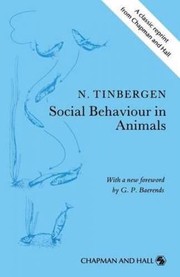
An edition of Social behaviour in animals (1953)
Social behaviour in animals
With Special Reference to Vertebrates
By Tinbergen, Niko
Publish Date
1990
Publisher
Chapman & Hall
Language
eng
Pages
150
Description:
This is the revised translation of the Dutch original *Inleiding tot de diersociologie* [Introduction to Animal Sociology] published in 1946. The 1st English edition was published in 1953, and went through several reprints: remarkable among them being the 1990 facsimile reprint, with a new foreword by G. P. Baerends. The Foreword details Tinbergen's views about the reissue of the book, prior to his death in 1988. From the author's Preface: THIS book is not intended as an exhaustive review of facts. Its aim is rather the presentation of a biological approach to the phenomena of social behaviour. This type of approach was revived by Lorenz's pioneer studies. It is characterized by emphasis on the need for renewed and careful observation of the huge variety of social phenomena occurring in nature; by emphasis on a balanced study of the three main biological problems - function, causation, evolution; by emphasis on an appropriate sequence of description, qualitative analysis, quantitative analysis; and finally by emphasis on the need for continuous re-synthesis. [...] The nature of the approach makes this book essentially different from other books on social behaviour. [...] I considered it of great importance to work out the formulation of the main problems, of their relation to each other and to more special, subordinated problems. This task, together with the necessary descriptions of many new facts found through 'naturalistic' study, and with the first qualitative steps of analysis, required much space. In addition, I wanted to formulate and emphasize some new theories which I consider important because of their great heuristic value. Thus the significance of intraspecific fighting, the causation of threat and courtship behaviour, the functions of releasers, and other problems to which the new approach has made distinct contribution~, have been presented in some detail, and an attempt has been made to give them their proper place in the complex system of problems.