An edition of La Poetica (1479)
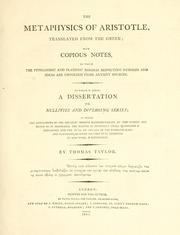
The metaphysics of Aristotle
translated from the Greek, with copious notes, in which the Pythagoric and Platonic dogmas respecting numbers and ideas are unfolded from antient sources. To which is added, a dissertation on nullities and diverging series...
By Aristotle
Publish Date
1801
Publisher
Printed for the author, by Davis, Wilks, and Taylor
Language
eng
Pages
312
Description:
Few, if any, writers in history have made major contributions to as many fields of knowledge as Aristotle... 'If there are two definitive features of ancient Greek civilization,' writes Hugh Lawson-Tancred in his wide-ranging Introduction, 'they are articulacy and competition.' In the city-states oratorical competence was an essential asset for politicians in the Assemblies and Councils and even for ordinary citizens in the courts of law. In response, the technique of rhetoric rapidly developed, bringing virtuoso performances and a host of practical manuals for the layman. Yet if many of these were little more than collections of debaters' tricks, the hugely influential Art of Rhetoric has a far deeper purpose. It is here that Aristotle (384-322 B.C.) establishes the methods of informal reasoning, provides the first aesthetic evaluation of prose style and offers detailed observations on character and the emotions. 'Persuasiveness,' suggests Lawson-Tancred, 'becomes for the first time a systematic and even scientific exercise; it can indeed be taught, but only by a deep grasp of some of the most central features of human nature.' His fine translation makes freshly available an epoch-making work of literary criticism.
subjects: Metaphysics, Early works to 1800, Metaphysica (Aristoteles), Rhetoric, ancient, Ethics, greece, Athens (greece), politics and government, Meteorology, early works to 1800, Aristotle, Philosophers, greece, Astronomy, early works to 1800, Animal locomotion, Philosophy, ancient, Rhetoric, Poetry, early works to 1800, Aesthetics, early works to 1800, Ancient Rhetoric, Poetry, Aesthetics, Esztétika, Irodalomelmélet, Költészet, Retorika, Rhétorique ancienne, Filosofia, Poétique, Rhétorique, Zoology, Pre-Linnean works, Philosophy, Collected Works, Classical philology, Philosophie, Ouvrages avant 1800, Filosofie, Poésie, Esthétique, 18.43 ancient Greek literature, 08.21 Ancient philosophy, Ancient Philosophy, Ancient Science, Science, ancient, Ethics, Economics, Poetics, Métaphysique, Criticism and interpretation, Pa3893 .r3 1991, 808.0092, Linguistics & semiotics, Ancient greek philosophy, Metaphysics--early works to 1800, B434.a5 b67 1994, 110, Philosophy--early works to 1800, B407 .a26 1996, 185, B407 .f56 1995, Psychology, Early works to 1850, Greek literature, History and criticism, Theory, Literary form, Ancient Aesthetics, Horses, Folklore, Translations into English, Literary Style, The Sublime, Long Now Manual for Civilization, Music, Philosophy and aesthetics, Sarcoptidae, Ancient Logic, Physical sciences, Animals, Ancient Ethics, Political science
People: Aristotle, Aristotle (384-322 B.C), Demetrius, Demetrius of Phaleron (b. 350 B.C), Demetrius, of Phaleron, Aristote
Times: Ancient Greece