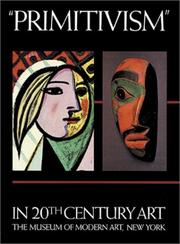
An edition of "Primitivism" in 20th century art (1984)
"Primitivism" in 20th century art
affinity of the tribal and the modern
By William Stanley Rubin
Publish Date
1984
Publisher
Museum of Modern Art,Distributed by New York Graphic Society Books
Language
eng
Pages
689
Description:
The crucial influence of the tribal arts--especially those of Africa and Oceania--on modern painters and sculptors has long been recognized. Yet surprisingly, this book is the first comprehensive scholarly treatment of the subject in half a century, and the first ever to illustrate and discuss tribal works collected by vanguard artists. In this visually stunning and intellectually provocative work, nineteen heavily illustrated essays by fifteen scholars confront complex aesthetic, art-historical, and sociological problems posed by this dramatic chapter in the history of modern art. The long introductory essay by William Rubin, while defining the parameters of modernist primitivism, sketches the history of western attitudes toward primitive peoples and, in particular, toward their art, raising fundamental questions and correcting widespread misconceptions.^ Succeeding background chapters by historians of primitive art trace the arrival and dissemination of African, Oceanic, American Indian, and Eskimo art in the West. In 1906 tribal sculpture was "discovered" by twentieth century artists; these objects had suddenly become relevant because of the changes in the nature of modern art itself. The main body of the book contains a series of essays on primitivism in the works of Gauguin, the Fauves, Picasso, Brancusi, the German Expressionists, Lipchitz, Modigliani, Klee, Giacometti, Moore, the Surrealists, Abstract Expressionists. It concludes with a discussion of primitivist contemporary artists, including those involved in earthworks, shamanism, and ritual -inspired performances. More than a thousand illustrations juxtapose on the pages of these volumes specific Primitive works with those of modernist masters, exploring their underlying affinities and illuminating intricate problems of influence and rapport.^ The tribal works illustrated include not only a variety of masterpieces pertinent to modernist interests, but other objects vital to the history of primitivism." -- Publisher's description