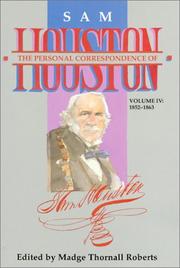
An edition of The Personal Correspondence of Sam Houston (1996)
The personal correspondence of Sam Houston
By Sam Houston
Publish Date
1996
Publisher
University of North Texas Press
Language
eng
Pages
571
Description:
In the April, 1971, issue of Southwestern Historical Quarterly , historian Llerena Friend wrote that there was a ?need for a new editing of Houston correspondence? to complement the eight-volume collection compiled in the 1930s by Eugene C. Barker and Amelia Williams. When author Madge Roberts began research for her previous book, Star of Destiny: The Private Life of Sam and Margaret Houston, she began to collect just such a file of previously unpublished Houston correspondence, which soon consisted of nearly a thousand letters. Because most of these letters were until recently in the hands of Houston descendants, most of them are ?personal? rather than ?political.? Although a few have been excerpted in various books and historical articles, none have been published in their entirety. In comparing these letters to those published in the Barker and Williams volumes, Roberts found that ?the personal letters often take the historian one step further,? as Houston felt more free to discuss his analyses of people and events than he did in his official correspondence. Houston was an extraordinary writer, in terms of both quantity and quality. His letters to friends and family overflow with lively details about manners, dress, medical practices, farming, transportation, family dynamics, and many other topics of interest to social historians. In her footnotes, Roberts reveals the full names of the people mentioned and the historical events taking place at the time, thus placing the letters into the broader context of Houston's life and times.--Amazon.com. Volume II of Sam Houston?s personal correpondence continues the four-volume series of previously unpublished personal letters to and from Sam Houston. This volume begins March 6, 1846, as Houston leaves Texas to take his place in the U. S. Senate. Included in his letters are comments on national politics and life in Washington, D. C., descriptions of politicians and their wives, and his observations on generals of the Mexican War. New information sheds light on his feelings towards being a candidate for the presidency. Family letters give a picture of life on Texas plantations during the mid-1800s. The letters end August 10, 1848, after problems with Oregon have begun and the Mexican War has ended. Volume III of Sam Houston?s personal correspondence continues the projected four-volume series of previously unpublished personal letters to and from Sam Houston. This volume begins in the fall of 1848 as Houston returns to Washington for the Second Session of the Thirtieth Congress after the close of the Mexican War. His first focus was on settling the Texas boundary and other problems relating to the welfare of his state. Once these were solved he seriously considered resigning his senate seat. However, he sensed the coming Civil War and seemed to feel that he should do all in his power to prevent it. Houston?s letters reflect the political activities as he struggled to maintain a strong Union stand against the radicals who favored secession. Intriguing new information comes to light on the plot to distract Houston, and perhaps get him out of the Senate, with an attack on Margaret?s character through their ward Virginia Thorne, resulting in Margaret?s indictment in 1850 on charges of assault and battery. His letters concerning the presidential election of 1852 are particularly interesting, as they are filled with colorful observations of the Washington social scene, as well as his thoughts concerning his own possible candidacy. Volume IV of this series brings to a close nearly ten years of research and publication of Sam Houston?s correspondence by Madge Thornall Roberts and the University of North Texas Press. As befitting a final volume in this series, it includes a comprehensive index of all four volumes. Volume IV continues with letters from 1852 showing Houston?s concern over the approaching Civil War and his hopeless struggle to prevent it. His letters during the Civil War prior to his death reveal his feelings on military strategy and his pride and mixed emotions as his eldest son joins the Confederate Army. Letters up until the time of Margaret?s death are also included as they add insight to family life during the Civil War and early Reconstruction. In addition, Volume IV includes letters from earlier periods uncovered after the publication of the previous volumes. These letters from his sisters, brother, and cousins are particularly interesting because they show concern over Houston?s resignation as governor of Tennessee and (later) the gravity of his San Jacinto wound. They also reveal the feelings of local Tennessee friends on the events in Texas.
subjects: Correspondence, Politics and government, Governors, Legislators, Houston, sam, 1793-1863, Texas, politics and government
People: Sam Houston (1793-1863)
Places: Texas, United States