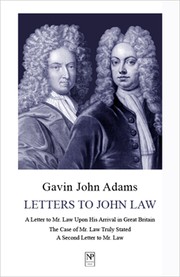
An edition of Letters to John Law (2012)
Letters to John Law
By Gavin John Adams
Publish Date
2012
Publisher
Newton Page
Language
-
Pages
162
Description:
John Law, the swashbuckling Scottish murderer, gambler and financial genius was at the epicenter of the European financial crises of the 1720s. Forced to flee France after engineering the first ever stock market boom and bust—and unleashing the most significant economic turmoil Europe had ever seen—his unannounced arrival in Britain divided the country, triggering elation and optimism in some, and outrage and fear in others. Letters to John Law is a collection of three uncompromising early eighteenth-century propagandist pamphlets documenting the wildly contrasting reactions to Law’s return to Britain. Included in the collection are: (1) A Letter to Mr. Law Upon His Arrival in Great Britain (Eustace Budgell, 1721); (2) The Case of Mr. Law Truly Stated, (Daniel Defoe, 1721); and (3) A Second Letter to Mr. Law. (Anonymous, 1721). Crafted by the most prominent journalists, commentators and political agitators of the day, each provides an invaluable contemporaneous social, political and historical record of the most remarkable story in financial history.
subjects: John Law, Banque Generale, Banque Royale, Mississippi Company, Mississippi Scheme, Mississippi Bubble, Money and Trade Considered, Stock Market Bubbles, Paper Money, Economics, Finance
People: John Law, Gavin John Adams, Daniel Defoe, Eustace Budgell, Sir John Blunt, James Craggs, Robert Harley, John Maynard Keynes, Robert Knight, Marquis de Lassay, Salathiel Lovell, Philippe II, Duke of Orleans, David Pulteney, James Roberts, Louis de Rouvroy, Adam Smith, James Francis Edward Stuart, Robert Walpole, Edward Wilson
Places: Aachen, Brussels, Copenhagen, Edinburgh, Hamburg, French Louisiana, Lauriston, Lauriston Castle, Mississippi, Munich, Paris, Venice, Bloomsbury Square, Chateau de Guermantes, Chelsea, Exchange Alley, Grub Street, Palazzo Mocenigo, Old Bailey, Ridotto, Rue Quincampoix, Stoke Newington
Times: 1718, 1719, 1720, 1721, Early Eighteenth-Century