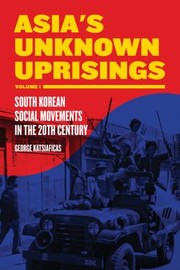
An edition of Asia’s Unknown Uprisings 1 (2012)
Han'guk ŭi minjung ponggi
minjung ŭl chuin'gong ŭro tasi ssŭn Namhan ŭi sahoe undongsa 1894 Nongmin chŏnjaeng-2008 Ch'otpul siwi
By George N. Katsiaficas
Publish Date
2015
Publisher
Owŏl ŭi Pom
Language
kor
Pages
452
Description:
Using social movements as a prism to illuminate the oft-hidden history of 20th-century Korea, this book provides detailed analysis of major uprisings that have patterned that country’s politics and society. From the 1894 Tonghak Uprising through the March 1, 1919, independence movement and anti-Japanese resistance, a direct line is traced to the popular opposition to U.S. division of Korea after World War Two. The overthrow of Syngman Rhee in 1960, resistance to Park Chung-hee, the 1980 Gwangju Uprising, as well as student, labor, and feminist movements are all recounted with attention to their economic and political contexts. South Korean opposition to neoliberalism is portrayed in detail, as is an analysis of neoliberalism’s rise and effects. With a central focus on the Gwangju Uprising (that ultimately proved decisive in South Korea’s democratization), the author uses Korean experiences as a baseboard to extrapolate into the possibilities of global social movements in the 21st century. Previous English-language sources have emphasized leaders—whether Korean, Japanese, or American. This book emphasizes grassroots crystallization of counter-elite dynamics and notes how the intelligence of ordinary people surpasses that of political and economic leaders holding the reins of power. It is the first volume in a two-part study that concludes by analyzing in rich detail uprisings in nine other places: the Philippines, Burma, Tibet, China, Taiwan, Bangladesh, Nepal, Thailand, and Indonesia. Richly illustrated, with tables, charts, graphs, index, and endnotes. (Source: [PM Press](https://www.pmpress.org/index.php?l=product_detail&p=375))
subjects: Social movements, Korea, social conditions, Social science, History, Revolutions, Social movements--history, Social movements--korea (south)--history, Revolutions--history, Revolutions--asia--history, Political participation--history, Political participation--asia--history, Social conflict--history, Social conflict--asia--history, Politics and government, Hn730.5.z9 s625 2012, 950.42
Places: Korea, South Korea, Korea (South), Asia