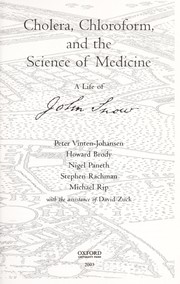
An edition of Cholera, chloroform, and the science of medicine (2003)
Cholera, chloroform, and the science of medicine
a life of John Snow
By Nigel Paneth,Stephen Rachman,David Zuck,Howard Brody
Publish Date
2003
Publisher
Oxford University Press
Language
eng
Pages
446
Description:
"The product of six years of collaborative research, this new biography interprets a pioneering figure in anesthesiology, epidemiology, medical cartography, and public health. It modifies the conventional rags-to-riches portrait of John Snow by synthesizing fresh information about his early life from archival research and recent studies. It explores the intellectual roots of his commitments to vegetarianism, temperance, and pure drinking water, first developed when he was a medical apprentice and assistant in the north of England. The authors argue that many of Snow's later contributions are traceable to the medical perspective he imbibed as a medical student in London and put into practice early in his career as a clinician: that medicine as a science required the incorporation of recent developments in its collateral sciences - chiefly anatomy, chemistry, and physiology - in order to understand the causes of a disease.^ Snow's theoretical breakthroughs in anesthesia were extensions of his experimental research in respiratory physiology and the properties of inhaled gases. Shortly thereafter, his understanding of gas laws led him to reject miasmatic explanations for the spread of cholera, and to develop an alternative theory that explained all facets of cholera epidemiology from transmission in households to the course of epidemics in cities and nations. Using all of Snow's extant writings, the authors follow him when working in his home laboratory, visiting patients throughout London, attending medical society meetings, and conducting studies during the cholera epidemics of 1849 and 1854. The result is a book that overturns much conventional belief about Snow, establishes his unique integrative scientific perspective, and demonstrates the importance of his specific contributions to medicine.^ It will have an impact not only on the understanding of the man but also on the history of the medical sciences in the era just preceding modern germ theory and bacteriology."--BOOK JACKET.