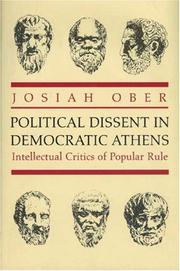
An edition of Political dissent in democratic Athens (1998)
Political dissent in democratic Athens
intellectual critics of popular rule
By Josiah Ober
Publish Date
1998
Publisher
Princeton University Press
Language
eng
Pages
435
Description:
How and why did the Western tradition of political theorizing arise in Athens during the late fifth and fourth centuries B.C.? By interweaving intellectual history with political philosophy and literary analysis, Josiah Ober argues that the tradition originated in a high-stakes debate about democracy. Since elite Greek intellectuals tended to assume that ordinary men were incapable of ruling themselves, the longevity and resilience of Athenian popular rule presented a problem: how to explain the apparent success of a regime "irrationally" based on the inherent wisdom and practical efficacy of decisions made by non-elite citizens? The problem became acute after two oligarchic coups d'etat in the late fifth century B.C. The generosity and statesmanship that democrats showed after regaining political power contrasted starkly with the oligarchs' violence and corruption. Since it was no longer self-evident that "better men" meant "better government," critics of democracy sought new arguments to explain the relationship among politics, ethics, and morality. Ober offers fresh readings of the political works of Thucydides, Plato, and Aristotle, among others, by placing them in the context of a competitive community of dissident writers. These thinkers struggled against both democratic ideology and intellectual rivals to articulate the best and most influential criticism of popular rule.
subjects: Historiography, Dissenters, Democracy, Intellectual life, Political aspects, Political activity, Athens (greece), politics and government, Démocratie, Historiographie, Dissidents, Activité politique, Vie intellectuelle, Aspect politique, Democratie, Tegenstanders, Politieke theorie, Histoire, Intellectuels, Opposition (science politique)
Places: Athens, Greece, Athens (Greece)