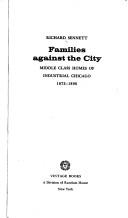
An edition of Families against the city (1970)
Families against the city
middle class homes of industrial Chicago, 1872-1890.
By Richard Sennett
Publish Date
1974
Publisher
Vintage Books
Language
eng
Pages
258
Description:
Families against the City portrays the life styles of middle class families in a Chicago community during the decades following the Civil War, when major American cities were experiencing massive development. The study focuses on Union Park, a section of Chicago that had been wealthy and elegant in the early years but gradually became a solidly middle class neighborhood of native-born lawyers, clerks, bookkeepers, and office workers. From three directions, Sennett explores how urban middle class families were structured, and how family structure, work, and the urban community influenced each other over two decades. He finds that the dominant mode of family life was of small “nuclear” units – a father, mother, and one or two children – that tended to withdraw from the city and make their homes places of refuge from the alien and fluctuating world outside. This was a refuge not dominated by the father, whose role was gradually weakening, but by the mother. He shows how this shift in family authority became a poignant source of strain between the generations: the sons looked to their fathers for guidance in dealing with the urban work world, but the fathers were as passive in the larger society as they were in the home. He suggests how this situation could have formed the root of that feeling of “father absence” and “mother-centered homes” which psychologists remark in modern, urban, middle class families.
subjects: Conditions sociales, Famille, Classes moyennes, Middle classes, Middle class families, Family, Chicago, Illinois, Chicago (Ill.), Social conditions, Internet Archive Wishlist, Middle class, united states, Chicago (ill.), social conditions, Families, Middle class
Places: Illinois, Chicago, Chicago (Ill.)