An edition of Children of the ice age (1996)
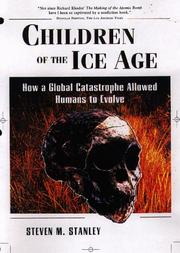
Children of the ice age
how a global catastrophe allowed humans to evolve
By Steven M. Stanley
Publish Date
1998
Publisher
W.H. Freeman
Language
eng
Pages
278
Description:
The contending theories of human evolution hold a special fascination for those who question the origin of human nature. In this book, prominent Johns Hopkins paleobiologist Steven M. Stanley proposes a bold new theory answering the classic chicken-or-egg question of human evolution: which came first, our bipedalism or the unprecedented size of our brains? With insight and remarkable common sense, Dr. Stanley argues that the confluence of environmental factors and developmental imperatives is the key to the mysteriously swift evolution from Australopithecus to Homo two-and-a-half-million years ago. While humans' unique brain is one of the most remarkable achievements of evolution, Stanley shows that it is intimately tied to our species' slow maturation and "postnatal helplessness," which requires extremely attentive parenting, particularly constant lifting and carrying of infants. This trade-off, which Stanley calls a "great evolutionary compromise," indicates that no tree-dwelling species could develop large brains. But if abandoning the trees was an evolutionary requisite for large brains, what can explain why our ancestors would choose the far more dangerous grassy terrain of Africa in the first place? A catastrophic change in the global climate, which Stanley links in a novel but convincing way to the formation of the Isthmus of Panama, is the answer Stanley unfolds in this anthropological detective story.
subjects: Human evolution, Australopithecines, Glacial epoch, Evolution