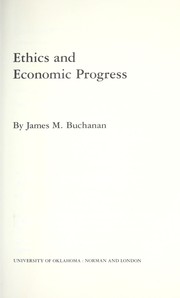
An edition of Ethics and economic progress (1994)
Ethics and economic progress
By James M. Buchanan
Publish Date
1994
Publisher
University of Oklahoma
Language
eng
Pages
156
Description:
In Ethics and Economic Progress, Nobel Prize-winning economist James M. Buchanan argues that ethical or moral constraints on human behavior exert important economic effects. He considers the question, Why are we better off by our own reckoning, when we work harder, save more, and deal honestly in markets and in politics? This nontechnical book opens up the entire economics-ethics nexus for examination. Part 1 examines behaviors and standards that can be subsumed under the term "Puritan ethics." The work ethic and the saving ethic may not be fashionable today, but Buchanan asserts that many modern attitudes and habits relate to the decline in productivity growth in the economy. If we acknowledge that moral values are important to our economic well-being, it follows that we must all "pay the preacher," on strictly economic grounds. Part II extends the argument, examining the implications for ethical norms that describe the behavior of taxpayers or public program users and the economics of the work ethic as it applies to nonlabor resources. The last chapter, perhaps the most controversial, suggests that Adam Smith's distinction between productive and nonproductive labor, which has been almost universally dismissed by economists, may indeed have economic relevance. Chapters 1, 2, and 3 were presented in 1991 as the first lectures in the W R. Howell, Sr., Second Century Lecture Series at the University of Oklahoma.
subjects: Moral and ethical aspects, Economics, Economic development, Moral and ethical aspects of Economic development, Work ethic, Moral and ethical aspects of Economics, Economische ontwikkeling, Economische ethiek, Ethische aspecten, Arbeitsethik, Wirtschaftsethik, Economics, moral and ethical aspects