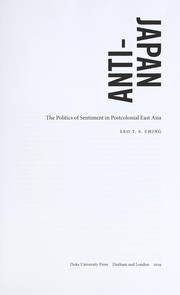
An edition of Anti-Japan (2019)
Anti-Japan
the politics of sentiment in postcolonial East Asia
By Leo T. S. Ching
Publish Date
2019
Publisher
-
Language
eng
Pages
170
Description:
Although the Japanese empire rapidly dissolved following the end of World War II, the memories, mourning, and trauma of the nation's imperial exploits continue to haunt Korea, China, and Taiwan. In 'Anti-Japan' Leo T. S. Ching traces the complex dynamics that shape persisting negative attitudes toward Japan throughout East Asia. Drawing on a mix of literature, film, testimonies, and popular culture, Ching shows how anti-Japanism stems from the failed efforts at decolonization and reconciliation, the Cold War and the ongoing U.S. military presence, and shifting geopolitical and economic conditions in the region. At the same time, pro-Japan sentiments in Taiwan reveal a Taiwanese desire to recoup that which was lost after the Japanese empire fell. Anti-Japanism, Ching contends, is less about Japan itself than it is about the real and imagined relationships between it and China, Korea, and Taiwan. Advocating for forms of healing that do not depend on state-based diplomacy, Ching suggests that reconciliation requires that Japan acknowledge and take responsibility for its imperial history.
subjects: HISTORY / Asia / General, Influence, Relations, East Asian Foreign public opinion, Imperialism, World War, 1939-1945, Nationalism, History, Asian history, Cultural studies, World war, 1939-1945, influence, Nationalism, japan, East asia, relations, foreign countries, Japan, relations, foreign countries, United states, relations, east asia, United states, foreign public opinion, International relations, Influence (Literary, artistic, etc.), 15.75 history of Asia, World War (1939-1945) fast (OCoLC)fst01180924
Places: United States, Japan, East Asia
Times: 20th century