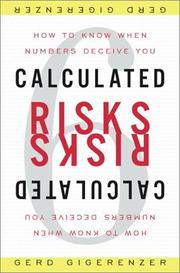
An edition of Calculated Risks (2002)
Calculated Risks
How To Know When Numbers Deceive You
By Gerd Gigerenzer
Publish Date
June 5, 2002
Publisher
Simon & Schuster
Language
eng
Pages
315
Description:
Gigerenzer explains that a major obstacle to our understanding of numbers is that we live with an illusion of certainty. Many of us believe that HIV tests, DNA fingerprinting, and the growing number of genetic tests are absolutely certain. But even DNA evidence can produce spurious matches. We cling to our illusion of certainty because the medical industry, insurance companies, investment advisers, and election campaigns have become purveyors of certainty, marketing it like a commodity. To avoid confusion, says Gigerenzer, we should rely on more understandable representations of risk, such as absolute risks. For example, it is said that a mammography screening reduces the risk of breast cancer by 25 percent. But in absolute risks, that means that out of every 1,000 women who do not participate in screening, 4 will die while out of 1,000 women who do, 3 will die. A 25 percent risk reduction sounds much more significant than a benefit that 1 out of 1,000 women will reap. This eye-opening book explains how we can overcome our ignorance of numbers and better understand the risks we may be taking with our money, our health, and our lives.
subjects: Probabilities, Mathematical statistics, Uncertainty, Popular works, Statistique mathématique, Wahrscheinlichkeit, 77.33 judgement, decison making (psychology), Entscheidung bei Unsicherheit, Risikoanalyse, Probability, Risk, Statistieken, Risico's, Onzekerheid, Besluitvorming, 70.03 methods, techniques and organization of social science research, Incertitude, Statistics as Topic, Anwendung, Ouvrages de vulgarisation, Probabilités, Statistik, Mathematics, popular works, Statistics