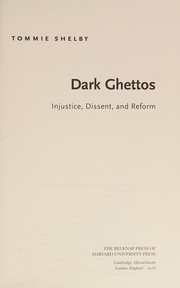
An edition of Dark ghettos (2016)
Dark ghettos
injustice, dissent, and reform
By Tommie Shelby
Publish Date
2016
Publisher
The Belknap Press of Harvard University Press
Language
eng
Pages
340
Description:
"Why do ghettos persist?" Tommie Shelby asks in Dark Ghettos. Today, ghettos are widely seen as social problems that public policy should aim to solve. Shelby calls this the "medical model" because it portrays ghettos as sick patients in need of treatment. In his view, this model ignores the political agency of the ghetto poor and the underlying social structures that perpetuate disadvantage in black communities. Shelby argues that we should conceive of ghettos within a "justice paradigm" instead. Adopting a Rawlsian framework, he considers the existence of ghettos as a sign of deeply embedded social injustice, and he offers a "nonideal" social theory, establishing what the government and citizens are obligated and permitted to do within fundamentally unfair conditions. His theory arises through practical considerations: should the American government enforce residential diversity? Should welfare programs disincentivize single motherhood? For those who live in ghettos, is voluntary non-work--or street violence, or hip-hop--a just and valid form of dissent? Ultimately, Shelby aims to establish principles that will lead to the abolishment of ghettos through just reform.--
subjects: Inner cities, Racism in public welfare, Government policy, Social conditions, African Americans, Social justice, African americans, social conditions, Racism, Justice sociale, Racisme dans l'aide sociale, Noirs américains, Conditions sociales, PHILOSOPHY / Political, Armut, Schwarze, Soziale Situation, Soziale Ungleichheit, Sozialpolitik, Stadtviertel, Cities and towns, Segregation, Urban Sociology
Places: United States