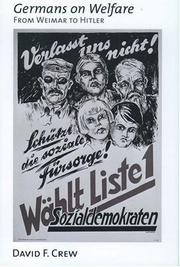
An edition of Germans on Welfare (1998)
Germans on welfare
from Weimar to Hitler
By David F. Crew
Publish Date
1998
Publisher
Oxford University Press
Language
eng
Pages
296
Description:
The welfare state was one of the pillars of the Weimar Republic. The Weimar experiment in democracy depended to no small degree upon the welfare system's ability to give German citizens at least a fundamental level of material and mental security in the face of the new risks to which they had been exposed by the effects of the lost war, revolution, and inflation. But the problems of the postwar period meant that, even in its best years, the Weimar welfare state was dangerously overburdened. The onset of the Depression and the growth of mass unemployment after 1929 destroyed republican democracy and the welfare state upon which it was based. On the ruins of Weimar's social republic, the Nazis built a murderous racial state. Adopting a "history of everyday life" perspective, Germans on Welfare: From Weimar to Hitler, shows how welfare discourse and policy were translated into welfare practices by local officials and appropriated, contested, and re-negotiated by millions of welfare clients.
subjects: History, Poor, Social conditions, Social policy, Public welfare, Public Assistance, Social Welfare, Aide sociale, Conditions sociales, Weimar-republiek, Armenzorg, Politique sociale, Fursorge, Sozialpolitik, Public Policy, Welzijnszorg, 1918-1933, 20th century, Histoire, BMBF-Statusseminar gnd, Wohlfahrtsstaat, Poverty, Pauvrete, Germany, Public welfare, europe, Germany, social conditions, Germany, politics and government, 1918-1933, Public welfare, germany
Places: Germany
Times: 20th century, 1918-1933