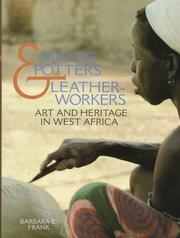
An edition of Mande potters & leatherworkers (1998)
Mande potters & leatherworkers
art and heritage in West Africa
By Barbara E. Frank
Publish Date
1998
Publisher
Smithsonian Institution Press
Language
eng
Pages
192
Description:
Among the Mande-speaking groups dispersed throughout much of West Africa, certain artists - including potters and leatherworkers - form a spiritually powerful social class in which gender determines craft specialization. Ceramic water jars and cooking pots are made only by the wives and female relatives of blacksmiths. Leather objects such as knife sheaths, amulet cases, and, more recently, western-style shoes and bags are produced by male leatherworkers. Analyzing the work of Mande potters and leatherworkers, Barbara E. Frank argues that studying craft technologies in addition to object styles is essential for reconstructing the art heritage of an ethnically complex region. Examining the roles of Mande leatherworkers and potters in the rise and fall of empires, the development of trans-Saharan trade networks, and the spread of Islam, Frank questions the "one-tribe, one-style" interpretations that have dominated studies of West African art. Focusing on two traditions that have been little studied, Mande Potters and Leatherworkers explores the complex, shifting relationships among the identities of Mande craftspeople, the objects they create, and the technologies they use.
subjects: Art, West African, Industries, Leatherwork, Mandingo, Mandingo (African people), Mandingo Leatherwork, Mandingo Pottery, Pottery, Mandingo, Sex role, Sex role in art, Sexual division of labor, West African Art, Pottery, african, Leatherwork, Ethnology, africa, west, Art, african, Mandingo (african people)--industries, Art, african--africa, west, Sex role--africa, west, Sexual division of labor--africa, west, Dt474.6.m36 f73 1998, 738/.089/96345, African Art
Places: West Africa