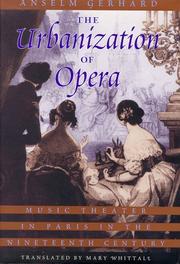
An edition of The Urbanization of Opera (1997)
The Urbanization of Opera
Music Theater in Paris in the Nineteenth Century
By Anselm Gerhard
Publish Date
August 15, 1998
Publisher
University Of Chicago Press
Language
eng
Pages
526
Description:
Why do so many operas end in suicide, murder, and death? Why do many characters in large-scale operas exhibit neurotic behaviors worthy of psychoanalysis? Why are the legendary grands operas - much celebrated in their time - so seldom performed today? Anselm Gerhard argues that such questions can only be answered by recognizing that daily life in rapidly urbanized mid-nineteenth-century Paris introduced not just new socioeconomic and political forces, but also new modes of perception and expectations of art. Attempting to respond to changes in urban life and psychological outlook, librettists and composers of grand opera developed new forms and conventions, as well as new staging and performance practices - for instance, the tableau, in which the chorus typically plays the role of a destructive mob. These larger urban and social concerns - crucial to our understanding of nineteenth-century opera - are brought to bear in fascinating discussions of eight operas composed by Rossini, Auber, Meyerbeer, Verdi, and Louise Bertin. This unique look at nineteenth-century European culture through the opera glass will appeal to both opera fans and scholars.
subjects: Opera, Social aspects, Social aspects of Opera, Opera, history and criticism, Opera, france
Times: 19th century