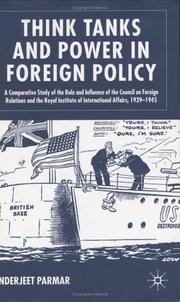
An edition of Think tanks and power in foreign policy (2004)
Think tanks and power in foreign policy
a comparative study of the role and influence of the Council on Foreign Relations and the Royal Institute of International Affairs, 1939-1945
By Inderjeet Parmar
Publish Date
2004
Publisher
Palgrave Macmillan
Language
eng
Pages
267
Description:
"What is the role of elites in shaping foreign policy? Did unaccountable foreign policy elites shape the post-1945 world order? As Britain and the United States draw ever closer in global affairs, Think Tanks and Power in Foreign Policy examines the intellectual and political forces that constructed a resilient Anglo-American alliance during the Second World War. Chattam House and the Council on Foreign Relations were vital in America's shift from isolationism to globalism, and in Britain's shift from Empire to its current pro-American orientation and were also fundamental in engineering public backing for a new world order. This study locates the think tanks within their respective foreign policy establishments and also considers their numerous transatlantic interconnections - social, political and economic. Finally, the historical evidence is tested against important theories of power, including Gramscian, pluralist, corporatist and statist. Inderjeet Parmar presents new evidence to show how well-organised and well-connected elite think tanks helped to change the world."--BOOK JACKET.
subjects: Council on Foreign Relations, Diplomatic history, Foreign relations, History, Public opinion, Research institutes, Royal Institute of International Affairs, World War, 1939-1945, World war, 1939-1945, diplomatic history, Public opinion, united states, Public opinion, great britain, United states, foreign relations, 1933-1945, Great britain, foreign relations
Places: Great Britain, United States
Times: 1933-1945, 1936-1945, 20th century