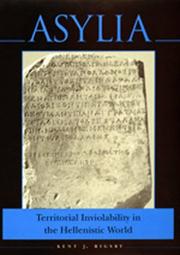
An edition of Asylia (1996)
Asylia
Territorial Inviolability in the Hellenistic World (Hellenistic Culture and Society)
By Kent J. Rigsby
Publish Date
March 28, 1997
Publisher
University of California Press
Language
eng
Pages
666
Description:
In the Hellenistic period certain Greek temples and cities came to be declared "sacred and inviolable," meaning immune from war. A famous passage of Tacitus describes the appeals of many cities for Roman confirmation of the title. The evidence for this phenomenon - mainly inscriptions and coins - is scattered in the published record, but the material has never been collected and presented in one publication until now. In Asylia: Territorial Inviolability in the Hellenistic World, Kent J. Rigsby lays out these documents and discusses their historical implications. Rigsby argues that while a hopeful intention of military neutrality lay behind this diplomatic gesture, the declarations of asylum did not in fact change the military behavior of the Greeks; declared inviolability in effect became primarily a civic and religious honor for which cities across the Greek world competed during the third to first centuries B.C. Of the many civic titles for which Greek cities competed by Roman Imperial times, this was the first. In the Hellenistic period certain Greek temples and cities came to be declared "sacred and inviolable," meaning immune from war. A famous passage of Tacitus describes the appeals of many cities for Roman confirmation of the title. The evidence for this phenomenon - mainly inscriptions and coins - is scattered in the published record, but the material has never been collected and presented in one publication until now. In Asylia: Territorial Inviolability in the Hellenistic World, Kent J. Rigsby lays out these documents and discusses their historical implications. Rigsby argues that while a hopeful intention of military neutrality lay behind this diplomatic gesture, the declarations of asylum did not in fact change the military behavior of the Greeks; declared inviolability in effect became primarily a civic and religious honor for which cities across the Greek world competed during the third to first centuries B.C. Of the many civic titles for which Greek cities competed by Roman Imperial times, this was the first.
subjects: Asylum, Right of (Greek law), History, Religious aspects, Religious aspects of Asylum, Right of (Greek law), Sacred space, Law, greek, Asylum, right of, LAW, Constitutional, Public, Administrative Law & Regulatory Practice, Vrije steden, Hellenisme, Oudheid, Asielrecht, Droit d'asile (droit grec), Lieux sacrés, Histoire, Aspect religieux, Asyl, Diplomatie, Hellenismus, Droit d'asile, Lieu sacré, Law - Non-U.S., Law, Politics & Government, Law - Africa, Asia, Pacific & Antarctica, Grèce
Places: Greece