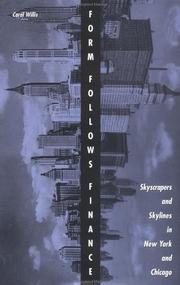
An edition of Form follows finance (1995)
Form follows finance
skyscrapers and skylines in New York and Chicago
By Carol Willis
Publish Date
1995
Publisher
Princeton Architectural Press
Language
eng
Pages
219
Description:
Although fundamental factors of program, technology, and economics make tall buildings everywhere take similar forms, skyscrapers in New York and Chicago developed very differently in the first half of the 20th century. In contrast to standard histories that counterpose the design philosophies of the Chicago and New York "schools," Form Follows Finance shows how market formulas produced characteristic forms in each city - "vernaculars of capitalism" - that resulted from local land-use patterns, municipal codes, and zoning. Refuting some common cliches of skyscraper history such as the equation of big buildings with big business and the idea of a "corporate skyline," this book emphasizes the importance of speculative development and the impact of real estate cycles on the forms of buildings. Form Follows Finance demonstrates that cities are complex commercial environments where buildings are businesses, space is a commodity, and location and image have value.
subjects: Office buildings, Economic aspects, Economic aspects of Office buildings, New york (n.y.), economic conditions, Chicago (ill.), economic conditions, Skyscrapers, Office buildings--new york (state)--new york, Office buildings--economic aspects, Office buildings--economic aspects--new york (state)--new york, Office buildings--illinois--chicago, Office buildings--economic aspects--illinois--chicago, Office buildings--new york (state)--new york--economic aspects, Office buildings--illinois--chicago--economic aspects, Na6232 .w55 1995, 725/.23/097471
Places: Chicago, Illinois, New York, New York (State)