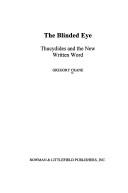
An edition of The blinded eye (1996)
The blinded eye
Thucydides and the new written word
By Gregory Crane
Publish Date
1996
Publisher
Rowman & Littlefield Publishers
Language
eng
Pages
277
Description:
Thucydides, the patron saint of realpolitik, continues to be read in many fields outside of classics. Why did his History succeed in setting the pattern for future scholars where Herodotus's earlier Histories failed? In this fascinating study of the construction of intellectual authority, Gregory Crane argues that Thucydides was successful for two reasons. First, he refined the language of administration: Who was in charge? How much money was spent? How many people were killed? Second, he drew upon the abstract philosophical rhetoric developing in the fifth century, in which the state and the public, rather than the family and the individual, stand at the center of the world. Ironically, it was through deeply personal alliances that aristocratic Greeks had traditionally defined themselves and exerted power. Thucydides's discursive practice was therefore fundamentally incompatible with his ideological goals. Crane hypothesizes that the resulting tension may have been what kept Thucydides from completing his work.
subjects: Criticism, Textual, Greece Peloponnesian War, 431-404 B.C., Greek prose literature, Historiography, History, Intellectual life, Textual Criticism, Written communication, Thucydides, Greek literature, criticism, textual, Greece, intellectual life, Greece, historiography
People: Thucydides
Places: Greece