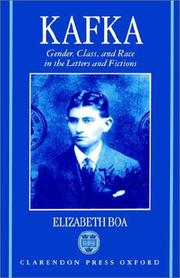
An edition of Kafka (1996)
Kafka
Gender, Class, and Race in the Letters and Fictions
By Elizabeth Boa
Publish Date
May 31, 1996
Publisher
Oxford University Press, USA
Language
eng
Pages
312
Description:
Elizabeth Boa's new study of Kafka centres on gender. It shows how, in an age of reactionary hysteria, Kafka rejected patriarchy yet exploited women as literary raw material. Drawing on Kafka's letters to his fiancee and to the Czech journalist, Milena Jesenska, Boa illuminates the transformation of details of everyday life into the strange yet uncannily familiar signs which are Kafka's stylistic hallmark. Kafka: Gender, Class, and Race in the Letters and Fictions argues that gender cannot be isolated from other dimensions of identity. The study relates Kafka's alienating images of the male body and fascinated disgust of female sexuality to the body-culture of the early twentieth century and to interfusing militaristic, racist, gender, and class ideologies. This is the context too for the stereotypes of the New Woman, the massive Matriarch, the lower-class seductress, and the assimilating Jew. The book explores Kafka's exploitation yet subversion of such stereotypes through the brilliant literary devices which assure his place in the modernist canon.
subjects: Austrian Authors, Authors, Austrian, Correspondence, Gender identity in literature, Jews in literature, Political and social views, Sex in literature, Social classes in literature, Kafka, franz, 1883-1924, Literary criticism - general & miscellaneous, Society & culture in literature, 20th century german literature - literary criticism, Social classes - general & miscellaneous, Gender identity
People: Franz Kafka (1883-1924)
Times: 20th century