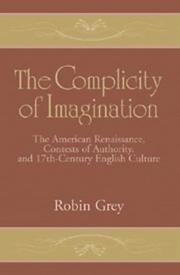
An edition of The complicity of imagination (1997)
The complicity of imagination
the American renaissance, contests of authority, and seventeenth-century English culture
By Grey, Robin
Publish Date
1997
Publisher
Cambridge University Press
Language
eng
Pages
303
Description:
The Complicity of Imagination examines the rich and complex relationship between four nineteenth-century authors and the culture and politics of seventeenth-century England. Challenging the notion that antebellum Americans were burdened by a sense of cultural inferiority in both their thought and their writing, this study portrays an American Renaissance whose writers were familiar enough with the literature and controversies of seventeenth-century England to appropriate its cultural artifacts for their own purposes. American writers such as Emerson, Fuller, Thoreau, and Melville consciously absorbed literary, philosophical, and political strategies from their reading in the earlier period in order to interrogate the orthodoxies of American Whigs, as well as the agenda of the radical Democratic 'Young Americans.' By exploring the broader cultural implications of intertextual relationships, this book demonstrates how literary texts participate in the artistic, political, and theological tensions within American culture.
subjects: England, Knowledge, English literature, History and criticism, American literature, Theory, Appreciation, Civilization, English influences, Fuller, margaret, 1810-1850, Emerson, ralph waldo, 1803-1882, Thoreau, henry david, 1817-1862, Melville, herman, 1819-1891, American literature, history and criticism, 19th century, American literature, foreign influences, English literature, history and criticism, early modern, 1500-1700, Great britain, civilization, Amerikaans, General, Engels, American, LITERARY CRITICISM, Bellettrie
People: Margaret Fuller (1810-1850), Ralph Waldo Emerson (1803-1882), Henry David Thoreau (1817-1862), Herman Melville (1819-1891)
Places: United States, England