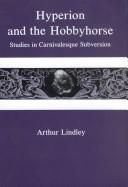
An edition of Hyperion and the hobbyhorse (1996)
Hyperion and the hobbyhorse
studies in carnivalesque subversion
By Arthur Lindley
Publish Date
1996
Publisher
University of Delaware Press,Associated University Presses
Language
eng
Pages
197
Description:
This book constructs a paradigm for the operation of subversive comedy - what Arthur Lindley, the author, calls the Augustinian carnivalesque - by examining some of the major texts of Ricardian and Elizabethan literature. By identifying some common characteristics of these works, Lindley argues that they must be seen in terms of a continuous, fundamentally Augustinian, Christian culture that is marked by a pervasive anti-heroic comedy that interrogates the official secular order and the role-based social identities that comprise it. Underlying this is a common attitude of Christian skepticism and a common use of carnivalesque demystification of power. In this pattern of continuity, concern with subjectivity, the mysteries of the self, and the tension between inward consciousness and outward role long antedates, say, Hamlet. Subjection, in other words, is not an Elizabethan (or Shakespearean) invention, but a constant concern of Augustinian literature going back to Confessions.
subjects: Carnival in literature, Characters, Dissenters in literature, English drama, English poetry, Gawain and the Grene Knight, Heroes, History, History and criticism, Literature and society, Revenge in literature, Social norms in literature, Social problems in literature, Wife of Bath, Wife of Bath (Fictitious character), Sir Gawain and the Green Knight, Shakespeare, william, 1564-1616, antony and cleopatra, Shakespeare, william, 1564-1616, hamlet, Chaucer, geoffrey, -1400, Marlowe, christopher, 1564-1593, English poetry, history and criticism, middle english, 1100-1500
People: Christopher Marlowe (1564-1593), Geoffrey Chaucer (d. 1400), William Shakespeare (1564-1616)
Places: England
Times: Early modern and Elizabethan, 1500-1600, Middle English, 1100-1500