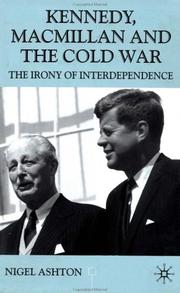
An edition of Kennedy, Macmillan, and the Cold War (2002)
Kennedy, Macmillan, and the Cold War
the irony of interdependence
By Nigel John Ashton
Publish Date
2002
Publisher
Palgrave Macmillan
Language
eng
Pages
288
Description:
"Based on extensive research in both Britain and the United States, this study analyses Anglo-American relations during a crucial phase of the Cold War. It argues that although policy-makers on both sides of the Atlantic used the term 'interdependence' to describe their relation-ship this concept had different meanings in London and Washington. The Kennedy Administration sought more centralized control of the Western alliance, whereas the Macmillan Government envisaged an Anglo-American partnership. This gap in perception gave rise to a 'crisis of interdependence' during the winter of 1962-3, encompassing issues as diverse as the collapse of the British EEC application, the civil war in the Yemen, the denouement of the Congo crisis and the fate of the British independent nuclear deterrent. This crisis was only partially mitigated by the personal friendship established between John F. Kennedy and Harold Macmillan. Overall, the Anglo-American relationship which emerges from this study is neither 'special' nor mythical, but complex and subtle."--BOOK JACKET.
subjects: Foreign relations, Cold War, Kennedy, john f. (john fitzgerald), 1917-1963, Macmillan, harold, 1894-1986, Cold war, United states, foreign relations, great britain, Great britain, foreign relations, united states, United states, foreign relations, 1961-1981, Europe - diplomatic relations with the u.s., 20th century american history - relations - general & miscellaneous, International relations - general & miscellaneous, Presidents of the united states - biography, Soviet history - political aspects
People: John F. Kennedy (1917-1963), Harold Macmillan (1894-)
Places: United States, Great Britain
Times: 1961-1963