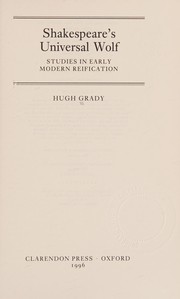
An edition of Shakespeare's universal wolf (1996)
Shakespeare's universal wolf
studies in early modern reification
By Hugh Grady
Publish Date
1996
Publisher
Clarendon Press,Oxford University Press
Language
eng
Pages
241
Description:
Shakespeare was neither a Royalist defender of order and hierarchy nor a consistently radical champion of social equality, but rather simultaneously radical and conservative as a critic of emerging forms of modernity. Hugh Grady argues that Shakespeare's social criticism in fact often parallels that of critics of modernity from our own Postmodernist era. Thus the broad analysis of modernity produced by Marx, Horkheimer and Adorno, Foucault, and others can serve to illuminate Shakespeare's own depiction of an emerging modernity - a depiction epitomized by the image in Troilus and Cressida of 'an universal wolf' of appetite, power, and will. The readings of Troilus and Cressida, Othello, King Lear, and As You Like It in Shakespeare's Universal Wolf demonstrate Shakespeare's keen interest in what twentieth-century theory has called 'reification' - a term which designates social systems created by human societies but which confront those societies as operating beyond human control, according to an autonomous 'systems' logic - in nascent mercantile capitalism, in power-oriented Machiavellian politics, and in the scientistic, value-free rationality which Horkheimer and Adorno call 'instrumental reason'.
subjects: History, Literature and society, Postmodernism (Literature), Political and social views, Social problems in literature, Alienation (Social psychology) in literature, Historical materialism, Civilization, Modern, in literature, Shakespeare, william, 1564-1616, political and social views, Shakespeare, william, 1564-1616, troilus and cressida, Shakespeare, william, 1564-1616, as you like it, Shakespeare, william, 1564-1616, Reification
People: William Shakespeare (1564-1616)
Places: England
Times: 17th century, 16th century