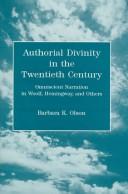
An edition of Authorial divinity in the twentieth century (1997)
Authorial divinity in the twentieth century
omniscient narration in Woolf, Hemingway, and others
By Barbara K. Olson
Publish Date
1997
Publisher
Bucknell University Press,Associated University Presses
Language
eng
Pages
152
Description:
Whatever a writer's religious assumptions and histories, the literary device of omniscient narration traps a writer into a pose as God, at least some sort of God, be it one the writer eschews, avows, or longs for. In this study, Barbara K. Olson examines the relationship between both the writer and the omniscient narrator to God. Olson explains how modernists Ernest Hemingway and Virginia Woolf both illustrate how authors' particular styles of omniscience bear a reliable though variable relation to their own or their culture's particular conceptions of God. The experience of novelists generally attests to perennial theological conundrums into which their creating and narrating have cast them - transcendence vs. immanence, providential care vs. cosmic capriciousness, determinism vs. freedom. Not surprisingly, such atheists as John Fowles and Ronald Sukenick have aimed their narrational experiments in omniscience at subverting what Fowles has called the "godgame" that this device requires. Such other writers as Flannery O'Connor, Graham Greene, and Murial Spark have predictably relied on the device as one consonant with their theistic assumptions.
subjects: Technique, Fiction, History, Point of view (Literature), Omniscience (Theory of knowledge), Narration (Rhetoric), History and criticism, Steam-boiler explosions, Geschichte 1920-1970, Auktoriales Erzahlen, Roman, Vertelperspectief, Alwetendheid, Fiction, history and criticism, 20th century, Knowledge, theory of, Fiction, technique
People: Virginia Woolf (1882-1941), Ernest Hemingway (1899-1961)
Times: 20th century