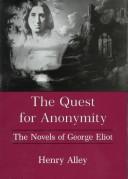
An edition of The quest for anonymity (1997)
The quest for anonymity
the novels of George Eliot
By Henry Alley
Publish Date
1997
Publisher
University of Delaware Press,Associated University Presses
Language
eng
Pages
182
Description:
In a new treatment of Eliot's booklength fiction, Alley argues that from the very moment she adopted a male pseudonym through to the major epic and tragic novels of her later life, the transcendence of fame was her major consideration. Focusing on one novel in each chapter, the study shows how the plights of Eliot's heroines and heroes do not end in frustration but in an affirmation of anonymous achievement, "the growing good of the world." For Eliot, heroism emerges through disclosure, rather than grandly executed action, and since the revelation requires discerning effort on the part of those watching, both observer and observed are celebrated. As Alley shows, no other subject in Eliot branches out so largely, so as to embrace all her artistic concerns, including her vision of her own biography and her need to adopt her pen name. Alley also demonstrates that for Eliot, the transcendent capacity to be unidentified creates a flexibility of mind that allows not only women but also men to shed confining personae and to be, in narrative form, both man and woman at the same time, an ability that imbues only the greatest of artists. The development of such models was evolutionary. Eliot drew on models from the Greek epics and tragedies, from Virgil, and from Shakespeare, Goethe, and Milton, to create her celebration of the unacknowledged. Out of the immortalized came the directive for extolling the anonymous, issuing in such great creations as Adam Bede, Daniel Deronda, Maggie Tulliver, Tertius Lydgate, Gwendolen Harleth, and Dorothea Brooke. Evolutionary, too, is Eliot's own discovery of her most prominent theme, with its greatest clarifications arriving in the masterpieces of her later period.
subjects: Didactic fiction, English, English Didactic fiction, Ethics, Heroes in literature, History, History and criticism, Quests (Expeditions) in literature, Self-denial in literature, Social ethics in literature, Women and literature, Morale, Critique et interprétation, Femmes et littérature, Histoire, Roman didactique anglais, Histoire et critique, Morale sociale dans la littérature, Abnégation de soi dans la littérature, Héros dans la littérature, Quête (Littérature), Littérature didactique anglaise, Abnégation, Dans la littérature, Héros, Eliot, george, 1819-1880
People: George Eliot (1819-1880)
Places: England
Times: 19th century