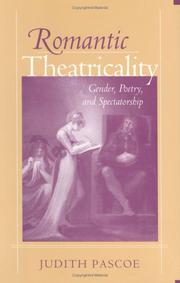
An edition of Romantic theatricality (1997)
Romantic theatricality
gender, poetry, and spectatorship
By Judith Pascoe
Publish Date
1997
Publisher
Cornell University Press
Language
eng
Pages
251
Description:
In a significant reinterpretation of early romanticism, Judith Pascoe shows how English literary culture in the 1790s came to be shaped by the theater and by the public's fascination with it. Pascoe focus on several intriguing historical occurrences of the late eighteenth and early nineteenth centuries, emphasizing how writers in all areas of public life relied on theatrical modes of self-representation. Pascoe adduces the theatrical posturing of the Della Cruscan poets, the staginess of the Marie Antoinette depicted in women's poetry, and the histrionic maneuverings of participants in the 1794 treason trials. Such public events as the trials also linked the newly powerful role of female theatrical spectator to that of political spectator. New forms of self-representation and dramatization arose as a result of that synthesis. Although its focus is on the substantial debt that romantic literature owes women writers, Romantic Theatrically also provides a new lens for viewing the creative endeavors of male romantic writers. Thus Pascoe documents William Wordsworth's strategic participation in the theatricality of early romantic culture.
subjects: History, History and criticism, Criticism and interpretation, English poetry, Feminism and literature, Performing arts in literature, Authors and readers, Romanticism, Women authors, Women and literature, Authorship, Self in literature, Sex differences, Wordsworth, william, 1770-1850, Robinson, mary (darby), 1758-1800, English poetry, history and criticism, 18th century, English poetry, women authors, Romanticism, great britain, Authorship, sex differences
People: William Wordsworth (1770-1850), Mary Robinson (1758-1800)
Places: England
Times: 18th century