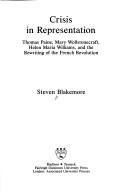
An edition of Crisis in representation (1997)
Crisis in representation
Thomas Paine, Mary Wollstonecraft, Helen Maria Williams, and the rewriting of the French Revolution
By Steven Blakemore
Publish Date
1997
Publisher
Fairleigh Dickinson University Press,Associated University Presses
Language
eng
Pages
273
Description:
This study describes how three prominent Anglo-American writers changed their early views of the French Revolution after the Terror of 1793-94. Thomas Paine, Mary Wollstonecraft, and Helen Maria Williams illustrate the crisis in representation confronting writers who had previously committed themselves to the Revolution of 1789. They were the principal participants in the ongoing revision of the French Revolution, not only because of their contemporary prominence, but also because they were living in revolutionary France during the Terror. The crisis in representation was, for them, intensely public and personal. All three responded by "writing out" the crisis - in the simultaneous sense of erasure and exposure - by reconceiving the Revolution through strategies and themes of repetition. Wollstonecraft and Williams explained the Terror as a "counterrevolutionary" return to the past, and both represented it as a repetitive version of Shakespeare's Macbeth. This intertextual revision is also resonant in the works of Thomas Paine. His historical contribution to the crisis was the recreation of himself as the revolutionary writer who had literally authored the American Revolution that, in turn, had "caused" the French Revolution. For Paine, Wollstonecraft, and Williams, the crisis in representation was actually a variety of representational crises. That they returned to the paradigms of the past to resolve the crisis signified that they were rewriting the Revolution within the textual space of the tradition they had originally opposed.
subjects: History, Historiography, Literature and the revolution, Foreign public opinion, Paine, thomas, 1737-1809, Wollstonecraft, mary, 1759-1797, France, history, revolution, 1789-1799, foreign public opinion, France, historiography, France, history, revolution, 1789-1799, literature and the revolution, French Revolution, Views on French Revolution
People: Mary Wollstonecraft (1759-1797), Helen Maria Williams (1762-1827), Thomas Paine (1737-1809)
Places: France
Times: Revolution, 1789-1799