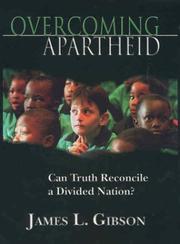
An edition of Overcoming apartheid (2004)
Overcoming apartheid
can truth reconcile a divided nation?
By Gibson, James L.
Publish Date
2004
Publisher
Russell Sage Foundation
Language
eng
Pages
467
Description:
"Overcoming Apartheid reports on a study of post-apartheid attitudes in South Africa, involving a representative sample of all major racial, ethnic, and linguistic groups. Grounding his analysis of "truth" in theories of collective memory, Gibson discovers that the process has been most successful in creating a common understanding of the nature of apartheid. His analysis then demonstrates how this common understanding is helping to foster "reconciliation," as defined by the acceptance of basic principles of human rights and political tolerance, rejection of racial prejudice, and acceptance of the institutions of a new political order. Gibson identifies key elements in the process - such as acknowledging shared responsibility for atrocities of the past - that are essential if reconciliation is to move forward. He concludes that without the truth and reconciliation process, the prospects for a reconciled, democratic South Africa would diminish considerably. Gibson also speculates about whether the South African experience provides any lessons for other countries around the globe trying to overcome their repressive pasts." "Overcoming Apartheid is also a primer for utilizing conceptual and methodological tools in analyzing truth processes throughout the world. It is a resource for political scientists, social scientists, group relations theorists, and students of transitional justice and human rights."--Jacket.
subjects: Government policy, Human rights, Reconciliation, Race relations, Political aspects of Reconciliation, Apartheid, South Africa, Political aspects of Truth, Truth, Amnesty, South Africa. Truth and Reconciliation Commission, History, Political aspects, Vergangenheitsbewältigung, Verzoening, Amnestie, Truth and Reconciliation Commission, Truth and reconciliation commissions, International criminal law, Wahrheits- und Versöhnungkommission, Südafrika Truth and Reconciliation Commission, Südafrika, Südafrika (Staat)
Places: South Africa