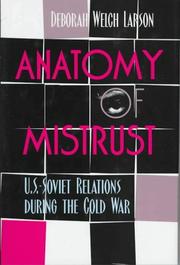
An edition of Anatomy of mistrust (1997)
Anatomy of mistrust
U.S.-Soviet relations during the Cold War
By Deborah Welch Larson
Publish Date
1997
Publisher
Cornell University Press
Language
eng
Pages
329
Description:
The United States and the Soviet Union missed numerous diplomatic opportunities to resolve differences and control the arms race because neither state trusted the other, according to Deborah Welch Larson. She shows that the goals of Soviet and U.S. leaders were frequently complementary, and an agreement should have been attainable. Lost opportunities contributed to bankruptcy for the Soviet Union, serious damage to the economy of the United States, decreased public support for internationalist policies, and a proliferation of nuclear weapons. Synthesizing different understandings of trust and mistrust from the theoretical traditions of economics, psychology, and game theory, Larson analyzes five cases that might have been turning points in U.S.-Soviet relations: the two-year period following Stalin's death in 1953; Khrushchev's peace offensive from the launching of Sputnik until the U-2 incident; the Kennedy administration; the Nixon-Brezhnev detente; and the Gorbachev period. Larson concludes that leaders in the United States often refused to accept Soviet offers to negotiate because they feared a trap.