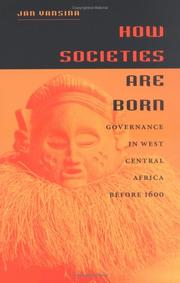
An edition of How societies are born (2004)
How societies are born
governance in West Central Africa before 1600
By Jan Vansina
Publish Date
2004
Publisher
University of Virginia Press
Language
eng
Pages
325
Description:
"Like stars, societies are born, and this story deals with such a birth. It asks a fundamental and compelling question: how did societies first coalesce from the small foraging communities that had roamed in West Central Africa for many thousands of years?" "Vansina employs a provocative combination of archaeology and historical linguistics to turn his scholarly focus to governance, studying the creation of relatively large societies extending beyond the foraging groups that characterized West Central Africa from the beginning of human habitation to around 500 B.C.E., and the institutions that bridged their constituent local communities and made large-scale cooperation possible." "The increasing reliance on cereal crops, iron tools, large herds of cattle, and overarching institutions such as corporate matrilineages and dispersed matriclans lead up to the developments treated in the second part of the book. From about 900 B.C.E. until European contact, different societies chose different developmental paths. Interestingly, these proceeded will beyond environmental constraints and were characterized by "major differences in the subjects which enthralled people," whether these were cattle, initiations and social position, or "the splendors of sacralized leaders and the possibilities of participating in such splendors.""--BOOK JACKET.
subjects: Politics and government, Tribal government, Political anthropology, Africa, sub-saharan, politics and government, Africa, central, history, Central Africa, Ethnogenesis, Society, Political systems, History, 0-999, 1000-1999, Gesellschaftsordnung, Stammesgesellschaft, Soziales System, Administration (government), Tribal groups, Africa, central, social conditions
Places: Sub-Saharan Africa, Central Africa