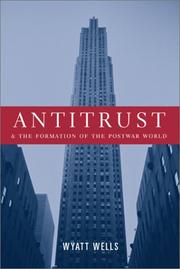
An edition of Antitrust and the formation of the postwar world (2001)
Antitrust and the formation of the postwar world
By Wyatt C. Wells
Publish Date
2002
Publisher
Columbia University Press
Language
eng
Pages
258
Description:
This book shows how the United States sought to impose--and with what results--its antitrust policy on other nations, especially in Europe and Japan. Wyatt Wells chronicles how the attack on cartels and monopoly abroad affected everything from energy policy and trade negotiations to the occupation of Germany and Japan. He shows how a small group of zealots led by Thurman Arnold, who became head of the Justice Departmentþs Antitrust Division in 1938, targeted cartels and large companies throughout the world: IG Farben of Germany, Mitsui and Mitsubishi of Japan, Imperial Chemical Industries of Britain, Philips of the Netherlands, DuPont and General Electric of the United States, and more. Wells shows how subsequently, the architects of the postwar economy--notably Lucius Clay, John McCloy, William Clayton, Jean Monnet, and Ludwig Erhard--uncoupled political ideology from antitrust policy, transforming Arnold's effort into a means to promote business efficiency and encourage competition.
subjects: Antitrust law, Cartels, Competition, Unfair, Conflict of laws, History, Unfair Competition, Wettbewerbspolitik, Kartellgesetz, Droit de la concurrence, Concurrence deloyale, Droit international prive, Concurrence, Histoire, Droit, Conflit des lois, Antitrustwetgeving, Unlauterer Wettbewerb, Law, united states, Droit international privé, Concurrence (Droit international privé), LAW, Taxation, Antitrust
Places: United States