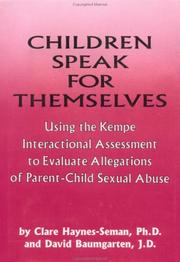
An edition of Children speak for themselves (1994)
Children speak for themselves
using the Kempe interactional assessment to evaluate allegations of parent-child sexual abuse
By Clare Haynes-Seman
Publish Date
1994
Publisher
Brunner/Mazel
Language
eng
Pages
192
Description:
Children Speak for Themselves examines the history, rationale, protocol, and theoretical bases for the Kempe Interactional Assessment and describes in detail the skills that are required and tasks that must be completed by the clinician in order to use the Kempe Interactional Assessment accurately and effectively. Firmly rooted in attachment theory, the Kempe Interactional Assessment is based on the fact that even preverbal and nonverbal children do "speak" for themselves about experiences with important people in their lives. By accurately recognizing, understanding, and translating children's communication, this method makes available for clinical and legal professionals crucial, firsthand information that might otherwise be ignored. In this book, you'll learn how the Kempe Interactional Assessment is comprised of three parts: a clinical interview with each parent in the presence of the child, videotaped observations of parent-child interactions, and an individual play interview with the child. Children Speak for Themselves presents highly detailed case illustrations that demonstrate the various ways that children communicate their experiences of sexual abuse and provide insight into how sexually abusing relationships develop and are maintained within a family system. These case studies also clearly illustrate the value of the Kempe Interactional Assessment when other techniques may not be effective - particularly when allegations involve young children, children caught up in an acrimonious divorce, or when the "outcry" is filtered through untreated survivors. The volume also examines how the Kempe Interactional Assessment can provide crucial clinical data about the qualities and dynamics of a family relationship that can reliably distinguish between sexually and nonsexually abusive relationships. Children Speak for Themselves will provide clinicians, attorneys, and other professionals involved in decision-making with a reliable clinical procedure that can not only easily reveal available data but can also help to uncover more covert information and verify whether abuse has occurred and by whom.