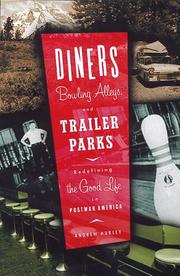
An edition of Diners, Bowling Alleys, and Trailer Parks (2001)
Diners, bowling alleys, and trailer parks
chasing the American dream in the postwar consumer culture
By Andrew Hurley
Publish Date
2001
Publisher
Basic Books
Language
eng
Pages
409
Description:
"The years immediately following World War II witnessed a dramatic transformation of America's working class suburbs, driven by unprecedented postwar prosperity and a burgeoning consumer culture. Chrome and neon were the currency in this newly vital consumer culture, and no postwar consumer institutions figured larger in this currency than diners, bowling alleys, and trailer parks. In tracing the rise of these three distinctively American institutions, Andrew Hurley examines the struggle of Americans with modest means to attain the good life after two long decades of depression and war.". "Shiny stainless-steel diners, clean, mechanized bowling alleys, and box-like trailer coaches arranged in neat rows were products of the new culture of abundance that grew in the late 1940s and '50s. These three quintessentially American institutions, each possessing a long and colorful pre-war history, underwent profound transformations in the postwar years as working-class families sought to assert themselves in the mainstream of American life. Stripped of their hardscrabble origins and unsavory reputations and made over with chrome and neon, these diners, bowling alleys, and trailer parks became physical manifestations of a newly urgent desire on the part of blue collar families to both enter the middle class and celebrate their arrival. And while diners, bowling alleys, and trailer parks were places where people enlarged the boundaries of the middle class, they were also places where proprietors and customers determined who would be granted access to the new American Dream and who would not. Touted as a force for egalitarianism and inclusion, more often than not these three institutions became battlegrounds where deep racial, ethnic, class, gender, and generational divides were revealed.". "Andrew Hurley tells this story of the humble origins, explosive growth, and gradual, sad decline of these erstwhile middle-class havens. Diners, Bowling Alleys, and Trailer Parks is substantial cultural and social history that also entertains. In narrating the history of these three institutions, Hurley opens a window onto the larger history of post-war America."--BOOK JACKET.
subjects: Consumption (Economics), Bowling alleys, Trailers, Economic conditions, Middle class, Diners (Restaurants), History
Places: United States
Times: 20th century, 1945-