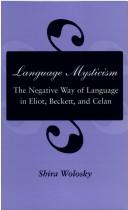
An edition of Language mysticism (1995)
Language mysticism
the negative way of languagein Eliot, Beckett, and Celan
By Shira Wolosky
Publish Date
1995
Publisher
Stanford University Press,Cambridge University Press [distributor]
Language
eng
Pages
318
Description:
Language Mysticism explores the place granted to language within metaphysical and theological hierarchies traditional to Western culture. Within these hierarchies, language represents embodiment, division, and historical differentiation; whereas silence points to an eternal unity beyond linguistic form and limitation. But this reflects a deeply embedded ambivalence in the Western tradition toward material and temporal conditions in general. The author uses the writings of T. S. Eliot, Samuel Beckett, and Paul Celan to show how far-reaching and immediate this history of ambivalence remains in its influence and consequences. In each of these writers, theological traditions inform and situate linguistic imagery and practices, albeit in quite different ways. The author argues that the stances toward language of these three writers register values not only fundamental to their work but general to our culture. Language is the sign of body, of history, of difference; and a negative attitude toward language therefore implies a displacement of value away from concrete, historical condition. The approach to language of Eliot, Beckett, and Celan therefore inscribes their struggle to define and locate the values that endow our lives with meaning, and the possibility of translating these values into historical reality.
subjects: Language, Mysticism in literature, History and criticism, Philosophy and religion in literature, Europeanliterature, European literature, Literature, Mysticism, soviet union, Beckett, samuel, 1906-1989, Languageeliot, t. s. (thomas stearns) , 1888-1965, Languagebeckett, samuel , 1906-1989, Languagecelan, paul, European literature--history and criticism, European literature--20th century--history and criticism, Pn771 .w65 1995, 809/.04
People: T. S. Eliot (1888-1965), Samuel Beckett (1906-1989), Paul Celan (1920-1970)
Times: 20th century